Article
SaaSpocalypse Averted


Image by Daniel Lincoln at Unsplash - https://unsplash.com/@danny_lincoln
For some time now, AI watchers have been predicting the SaaSpocalypse - a catastrophic collapse of the SaaS market because now anyone can replicate their products in a weekend with some vibe coding and a little light jazz playing in the background.
In January, Forbes reported that the SaaSpocalypse had actually begun after $300 billion was wiped off the market value of the big SaaS providers. It hadn't, but belief in the SaaSpocalypse is deep. Many small software businesses we speak to are very worried that it's only a matter of time before two teenagers copy their offering and undercut them on price.
Forbes adjusted their position in April, saying the SaaSpocalypse was dead, and actually, it's only the interface that's about to change.
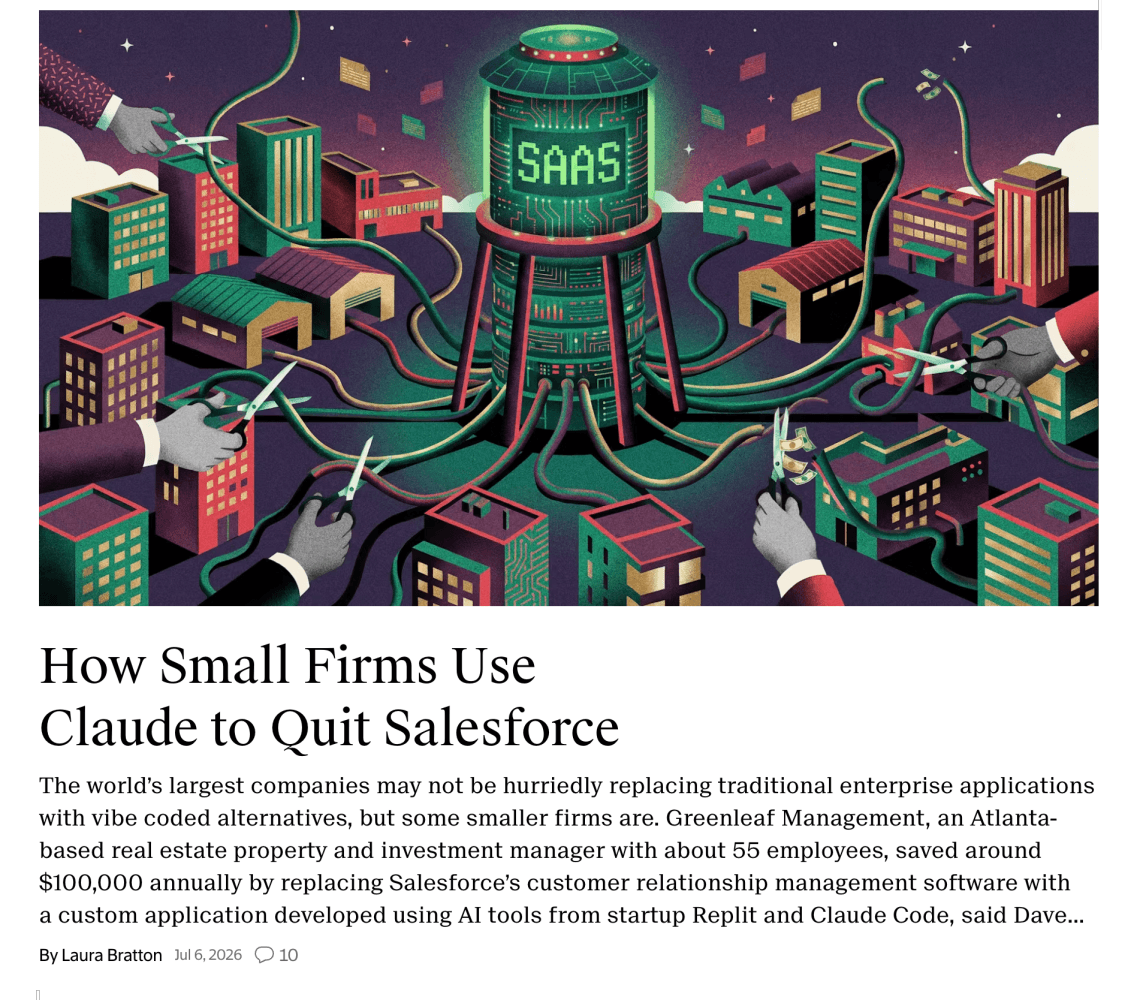
Confused? Well, only a few days ago, The Information, normally an extremely reliable breaker of tech news, published an article titled "How Small Firms Use Claude to Quit Salesforce" (it's behind a paywall, but the details were easy to track down), detailing how Greenleaf Management, a small real estate investment firm in the southeastern US "saved around $100,000 annually by replacing Salesforce’s customer relationship management software with a custom application developed using AI tools."
Sooo ... SaaSpocalypse II? I know what you Saased last summer? Saas Harder?
No. The whole SaaSpocalypse was a dumb concept that shows how scarce critical thinking is in 2026. What Greenleaf actually did is nothing like the headlines suggest. But it was good and it was illuminating. Here we'll explore what really happened and what it tells us about how the future is likely to go.
First, the facts.
The Greenleaf story is not recent. The case study on Replit is at least 8 months old. What happened is this - they did start off with Salesforce and the bill for that was about $100k, but as Dave Codrea, the partner involved, says, "Salesforce is ultra complex and can do all this really cool stuff. But I don't need all that stuff. I just need to keep track of who I've spoken to, who's on our distribution list."
Insight 1 they didn't need Salesforce in the first place. Not only are their requirements fairly simple, but their business is fairly bespoke in that they invest in wildly different property types from office conversions to low-income residential.
So Insight 2 is that they could have got Salesforce to work, but it would have been expensive (tens, maybe even hundreds of thousands of dollars via third party consultants on top of the annual fee) because what they do has a lot of unique characteristics.
A good tech person would look at "simple requirements" and "bespoke business model" and know that Salesforce was overkill.
And Greenleaf knew this too. Which is why they abandoned Salesforce. And moved to Google Sheets. OK, maybe they should have done that in the first place but there could be many rational reasons why they made a misstep. The main thing is they saw it and fixed it. Not by moving to an AI generated alternative but by following one of the most fundmental principles of Agile: do the simplest possible thing that works. Then learn. Then choose your next step.
Insight 3 Greenleaf made a small error, but they fixed it fast. That's all any of us can do. What they did not do was try to replicate Salesforce in a vibe coded app. Because, spoiler alert, no one can.
Salesforce isn't one of the dominant forces in CRM because it's easy to replicate. And, sure enough, the Replit case study confirms that the vibe code rebuild took around 25 hours. If you could rewrite Salesforce in 25 hours, Salesforce would have already done it and wiped out decades of design debt. If it could be done by someone else, it would have been done by now.
Besides, creating the vibe-coded app is like one squillionth of solving the problem.
What Greenleaf did was ask "what do we really need?" and "what's the simplest way to start that meets that need?" So, even though it must have been a bit painful, they moved to Google Sheets. And then they learned more precisely what they needed that Google Sheets could not do. And then they vibe coded an app. But "Vibe Coded App replaces free Spreadsheet App" does not make a great headline.
Greenleaf were never a good fit for Salesforce. Therefore Salesforce never really lost $100k of revenue. And Greenleaf got what they needed.
We might end the story there, except for that previous point: creating the vibe-coded app is like one squillionth of solving the problem. So Greenleaf now have an app which needs maintaining, updating, securing and so on. One decent developer and the $100k is back again. Not a bad thing. More a transfer of cost and responsibility.
Last time we mentioned the coming Algal Bloom of Shadow IT. Where core business apps, like the one at Greenleaf, fit nicely into existing organisational structures and practices, many will not. There are many more vibe-coded apps that sit outside of the grumpy unresponsive IT department that are already going stale and which represent potential security and future cost risks.
And now is the time to catalogue these. Here's a simple heuristic you can use to categorise them:
Scope and stability
Can we describe what this app does in one or two sentences?
Can we be clear about who uses the app and gets value from it?
Has the requirement the app was based on changed in the last twelve months?
Is it likely to change again?
Fit against big platforms
Where we could use a Saas product instead, would we be paying for capability we don't use?
Might we inadvertantly adopt a "buy the platform everyone else buys" strategy instead of focusing on the simplest tool that does what we need?
Does this need to integrate with other systems, or does it genuinely stand alone?
Ownership after launch
Who will maintain this in six months?
Will that person or group still be with the business in eighteen months?
Does the app hold customer or financial data?
Who is accountable for the security of the app if something leaks out?
Then collate those answers to answer this overriding question: What business value do we assign to this app existing and what is the fully loaded cost, including whoever's time goes into keeping it working, not just the subscription it replaces?
Those basic questions should help define where Saas is the right choice and where vibe coded (with appropriate follow-on responsibility) is better value.
If you'd like help getting the right vibes in your tribes, drop us a line.